 Hello,Welcome to StudentBro.
 Hello,Welcome to StudentBro.
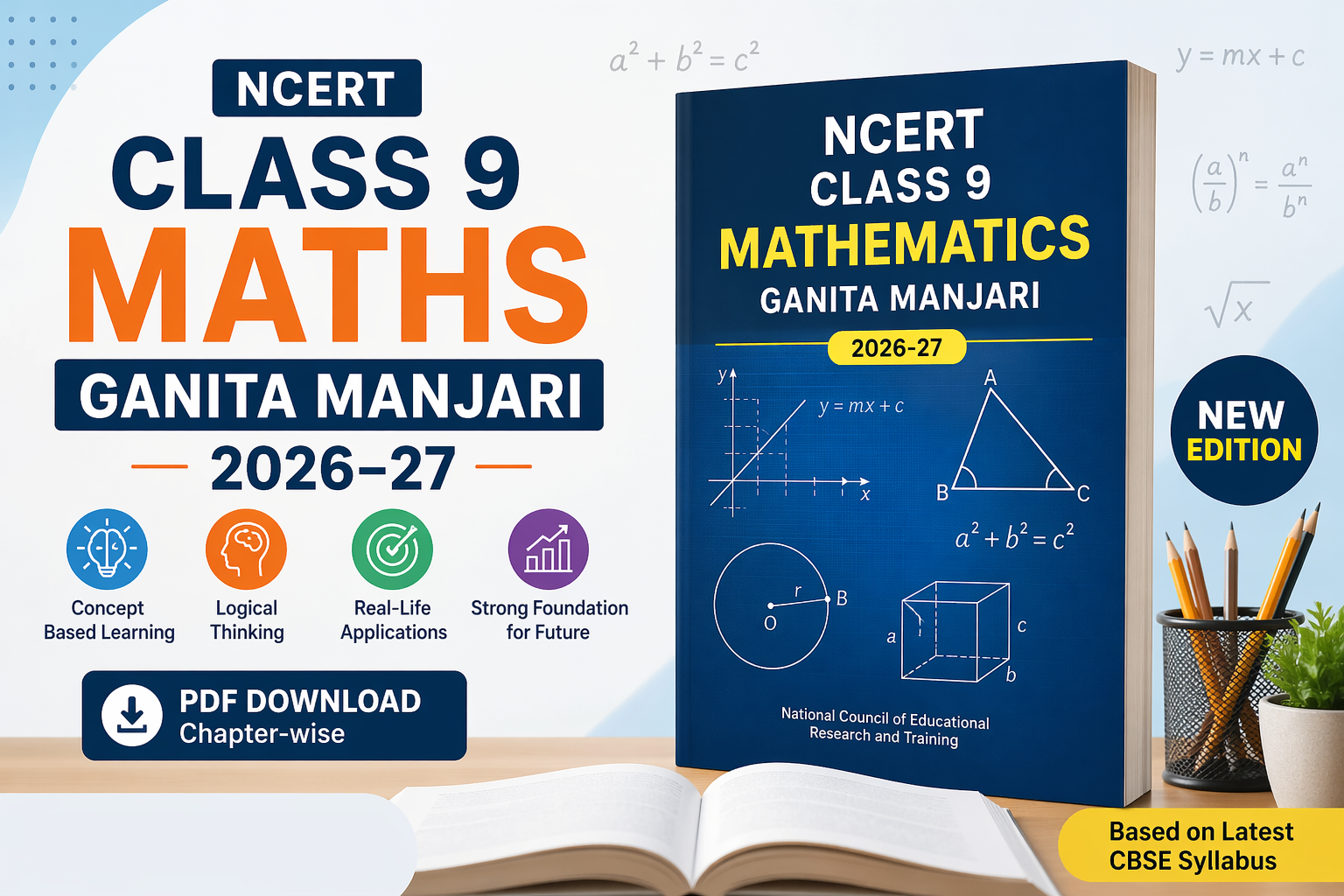
The NCERT Class 9 Maths – Ganita Manjari (2026–27) is the latest textbook introduced under the new education framework. It focuses on conceptual learning, logical reasoning, and real-life application of mathematics, making it more student-friendly and practical.
Students can download chapter-wise PDFs and study material easily from StudentBro.in for better preparation.
Ganita Manjari is the newly introduced mathematics textbook for Class 9 students. It replaces the traditional NCERT structure with a more interactive, reasoning-based approach.
Key highlights include:
This modern approach helps students understand mathematics deeply rather than just solving questions.
Class 9 Maths plays a crucial role in shaping a student’s academic journey as it builds a strong foundation for advanced topics in higher classes. It helps students develop clear concepts, logical reasoning, and analytical thinking skills that are essential for solving complex problems. This stage also prepares students for Class 10 board exams and creates a solid base for competitive exams like JEE and NDA. Students who master Class 9 Maths find it much easier to understand future concepts and perform better academically.
The updated book includes a structured learning approach with chapters designed to gradually build concepts.
The syllabus includes important topics such as:
Some versions of the updated book include around 8 redesigned chapters, focusing on depth rather than quantity.
Here is a quick overview of important chapters:
These topics form the core of Class 9 mathematics.
The NCERT Class 9 Maths Ganita Manjari (2026–27) is a modern and concept-based textbook designed to improve logical thinking and problem-solving skills. It is essential for academic success and future studies.
By using StudentBro resources, practicing regularly, and understanding concepts clearly, students can easily score high marks in Class 9 Maths.
1. Orienting Yourself- The Use of Coordinates
2. Introduction to Linear Polynomials
4. Exploring Algebraic Identities
5. I'm Up and Down, and Round and Round
6. Measuring Space- Perimeter and Area
7. The Mathematics of Maybe- Introduction to Probability
8. Predicting What Comes Next- Exploring Sequences and Progressions

StudentBro is an app that prioritizes understanding over rote learning. It helps students get answers to their questions anytime. Our goal is to use technology to simplify education and make learning accessible and affordable for all students in Gujarat.